If you’ve started shopping for outdoor shade, you’ve probably noticed the word “awning” covers a lot of ground. Retractable, fixed, motorized, manual, drop screens, custom structures — each style solves a different problem, and picking the wrong one for Charlotte’s heat, humidity, and sudden pop-up storms can mean disappointing shade or a system that doesn’t hold up. Here’s a straightforward breakdown of the main types of awnings, what each one is actually good for, and how to think about choosing between them.
Retractable Awnings
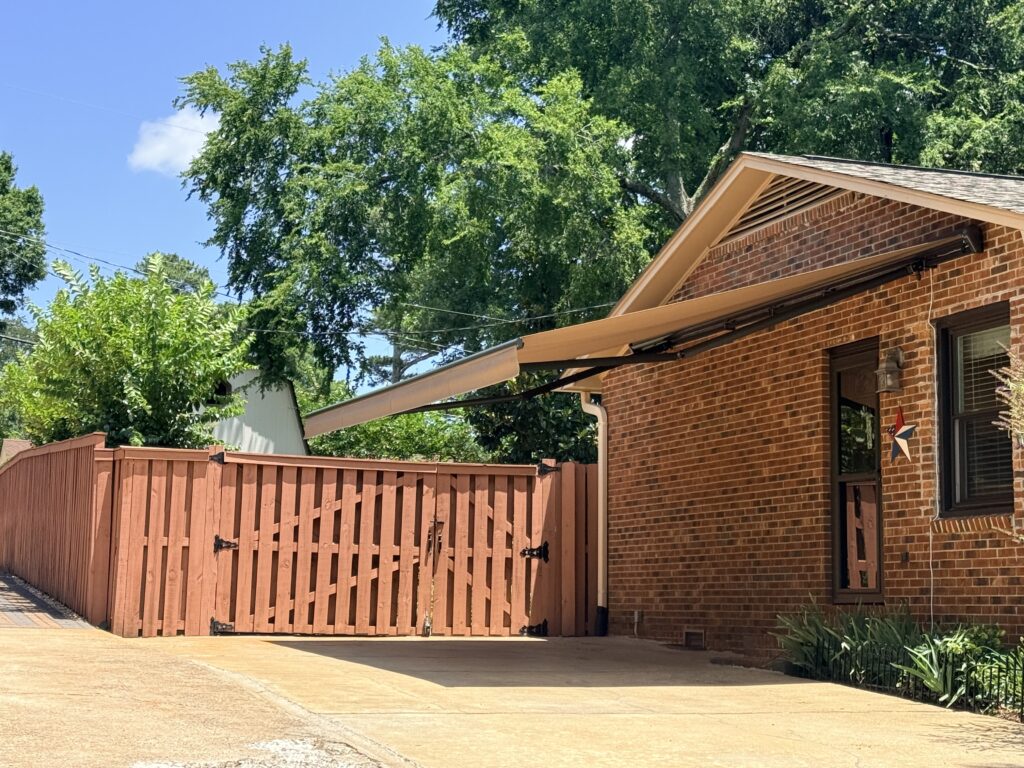
Retractable awnings are the most flexible option for a patio, deck, or storefront. The fabric extends on a folding arm system when you want shade and retracts back against the wall when you don’t — for a bright winter afternoon, a light rain, or simply when the space isn’t in use. That flexibility is why they’ve become the standard choice for homeowners who want one system that adapts through all four seasons instead of a fixed structure that shades (or doesn’t) year-round.
Because the fabric retracts, it also stays out of the weather far more than a permanent canopy would, which extends its usable life. Most retractable systems can be operated manually with a hand crank or upgraded to a motorized version with a remote, wall switch, or wind sensor that pulls the awning in automatically before a storm rolls through. For a deeper look at how these systems perform on Charlotte patios, see our guide to retractable awnings.
Fixed (Stationary) Awnings
A fixed awning is mounted permanently in one position — no motor, no folding arms, no retracting. They’re common over doorways, windows, and small porches, where a compact, always-on strip of shade and weather protection matters more than flexibility. Because there are no moving parts, fixed awnings are typically the lowest-maintenance and lowest-cost option in the category.
The tradeoff is exactly what you’d expect: a fixed awning shades the same footprint every day of the year, whether you want it to or not. It can block welcome winter sun, and because the fabric is always exposed, it takes more direct weathering over time than a system that retracts. Fixed awnings tend to work best on smaller architectural accents rather than as the primary shade solution for a full patio or outdoor living space.
Motorized vs. Manual Awnings
This distinction cuts across awning types rather than being a category on its own, but it’s one of the first decisions most homeowners have to make. A manual, crank-operated awning costs less upfront and has fewer components that can eventually need service. A motorized awning trades a higher initial investment for real convenience — one button retracts a wide awning that would otherwise take real effort to crank by hand, and features like wind sensors and app control add a layer of protection you simply can’t get manually.
For larger awnings — anything covering a full dining or lounge area — motorization tends to be worth it. For a small accent awning over a single window, manual operation is often all that’s needed.
Screen and Drop Shades
Where an awning shades from above, a screen or drop shade closes off the sides. These vertical, retractable screens mount along the edge of a covered patio, porch, or lanai and lower to block low-angle sun, wind-driven rain, and pests, while raising back out of the way when you want the space fully open. They’re especially useful paired with an existing roof, pergola, or retractable awning that already handles overhead shade but leaves the sides exposed.
Motorized screens have become a popular addition for Charlotte homeowners who want to extend how many months of the year a covered patio stays comfortable — closing out January wind or September pollen without giving up the open feel in July.
Custom Outdoor Shade Structures
Not every space fits a standard awning. Larger patios, pool decks, restaurant terraces, and uniquely shaped outdoor areas often call for a custom outdoor shade solution — a system built around the specific dimensions, mounting surfaces, and sun exposure of that space rather than a stock size. Custom structures might combine a retractable awning with drop screens, use multiple units working together, or incorporate features like integrated lighting for evening use.
The right custom configuration depends on how the space is actually used: a dining area needs different coverage than a lounge or pool deck. It’s worth working through those details with a specialist before ordering hardware.
Choosing Fabric and Frame
Whichever type you land on, two decisions shape how well it performs over time. Fabric quality determines how much UV protection, fade resistance, and mildew resistance you’re getting — solution-dyed acrylics generally outlast printed or budget vinyl-coated fabrics, especially in a humid climate. Frame material matters just as much: look for powder-coated aluminum with corrosion-resistant hardware, since anything less can start showing rust or pitting after a few Carolina summers of heat and storms.
What’s Right for Your Charlotte Patio
Charlotte’s climate is part of this decision, not separate from it. Long, humid summers make retractable and motorized options genuinely more useful here than in a milder climate, since you’ll likely be adjusting shade throughout the day rather than setting it once. Sudden thunderstorms make a wind sensor a worthwhile upgrade rather than a luxury. And our mix of older neighborhoods with brick facades alongside newer construction means mounting conditions vary a lot from house to house — which is exactly the kind of detail worth a site visit rather than a guess.
Simpli Shaded has spent years fitting the right awning, screen, or custom shade structure to homes across Charlotte, Raleigh, and the surrounding Carolinas, as an authorized SunPro dealer backed by a 10-year warranty. If you’re weighing your options, we’re happy to walk the space with you and talk through what actually fits — call (980) 290-5618 or request a free quote.
Related on Simpli Shaded: Motorized retractable awnings in Charlotte · Motorized screens · What a motorized awning costs · 0% APR financing for qualified buyers · Areas we serve

