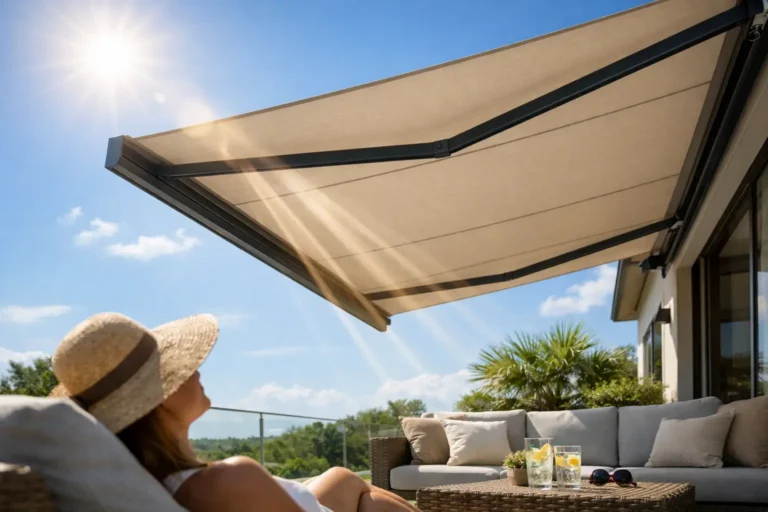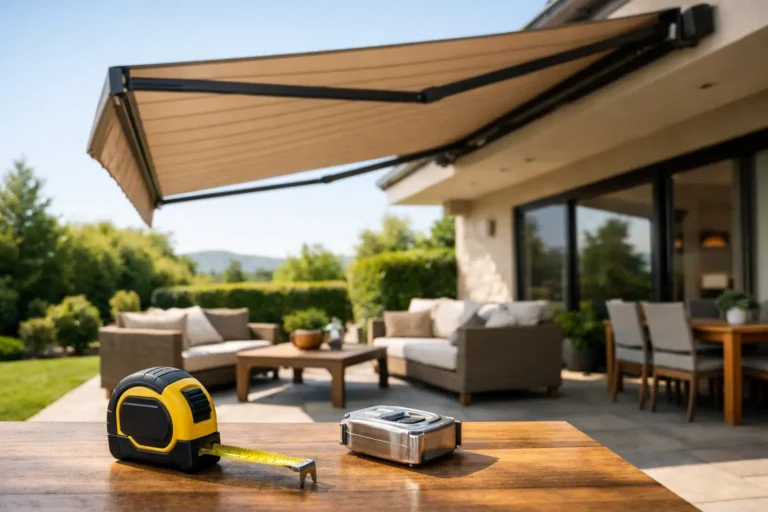
A retractable awning can have beautiful fabric, a quiet motor, and the right projection for a patio, yet its everyday performance still comes down to the awning hardware behind the scenes. The brackets, arms, fasteners, and controls carry the load, keep the canopy aligned, and help your outdoor space feel easy to use rather than fussy to maintain.

For homeowners, hardware is often the part of an awning that gets the least attention during the buying process. For designers and commercial property owners, it is often the detail that determines whether an installation looks polished and performs reliably over years of sun, wind, and changing temperatures. Choosing it well starts with understanding what it does and what your space requires.
What Awning Hardware Does
Awning hardware is the working structure that supports, opens, closes, anchors, and tensions an awning. On a retractable model, it includes the mounting brackets fixed to the building, the roller tube that holds the fabric, the articulated arms that extend the canopy, and the mechanism or motor that operates it. On fixed awnings, it may include frames, rafters, wall plates, support posts, and connection points.
These parts do more than hold fabric in place. They distribute weight across the mounting surface, maintain fabric tension, and manage the force created when an awning is extended. A smooth-looking canopy depends on correctly sized components working together. If the mounting system is wrong for the wall, or the brackets are spaced incorrectly, even a high-quality awning may sag, shift, or become difficult to operate.
Finish matters, too. Hardware is visible when an awning is retracted, particularly on clean-lined homes, modern pool decks, restaurant patios, and hospitality settings. A coordinated frame color helps the unit look intentional instead of added on as an afterthought.
The Hardware Parts Worth Knowing
You do not need to become an installer to make a confident decision, but knowing the basic components makes it easier to compare options and ask the right questions.
Mounting brackets and back plates
Brackets attach the awning to a wall, soffit, roof structure, or other approved mounting surface. They are among the most critical pieces of the system because they transfer the awning’s weight and operating forces to the building.
The correct bracket setup depends on the awning’s width, projection, model, and the material behind the exterior finish. Brick veneer, stucco, wood framing, concrete, and steel each require a different installation approach. A solid-looking exterior surface is not automatically a suitable attachment point. The hardware must be secured into structural material, not simply into siding, trim, or a thin masonry face.
For a wide awning or one with a deeper projection, additional brackets may be needed. This is not overbuilding. It is a practical way to spread the load and protect both the awning and the building.
Retractable arms
The folding arms are what give a retractable awning its reach. Internal springs and cables create tension so the fabric stays taut as the awning extends. Quality arms should move smoothly, hold a consistent pitch, and retract evenly without one side arriving home before the other.
Arm strength is especially relevant when you want generous shade over a large seating area, outdoor kitchen, or dining table. More projection creates more usable covered space, but it also creates more leverage against the mounting system. The right answer is not always the biggest awning available. It is the awning size and arm configuration that suits your wall, layout, and expected conditions.
Roller tubes and fabric bars
The roller tube stores the fabric when the awning is closed, while the front bar supports the leading edge when it is open. Both need to remain straight and properly supported to help the canopy roll cleanly and stay square.
This is one reason dimensions matter. A very wide awning can require heavier-duty components than a compact patio model. Choosing a system designed for its span helps prevent uneven rolling and makes the awning more pleasant to operate season after season.
Manual and motorized operating hardware
Manual awnings typically use a crank gear. They are straightforward and can be a practical choice for smaller spaces or occasional use. Motorized awnings use an integrated tubular motor, operated by a wall switch, remote, app, or smart-home control system depending on the model.
Motorization adds convenience, particularly for homeowners who use their patio frequently or commercial venues that need staff to adjust shade quickly. It also encourages regular use. When extending the awning takes a button press instead of a trip to find a crank, shade becomes part of the daily rhythm of the space.
Motorized systems can also accommodate wind sensors. These accessories are not substitutes for good judgment, but they can retract an awning when wind reaches a chosen threshold. They are valuable for homes that are occasionally unattended and for hospitality spaces with larger outdoor seating areas.
Choose Hardware for the Installation, Not Just the Awning
The best awning hardware is not selected in isolation. It must match the awning, the building, and how the outdoor area will be used.
Start with the mounting location. A wall-mounted installation is common, but roof, soffit, and freestanding solutions may make more sense when there is limited wall height, an unusual roofline, or a patio that sits away from the home. Each option has different structural requirements and visual considerations.
Next, consider exposure. A protected courtyard behaves differently from a second-story deck facing open water or a windy backyard corner. Retractable awnings are sun-protection products, not permanent roofs, and they should be retracted in high winds, storms, or heavy rain unless a specific product is rated for those conditions. Hardware built for outdoor use is durable, but no component can make an improperly used awning weatherproof.
Then think about access. A manual crank may be perfectly convenient on a ground-level patio, while a motorized option is usually more practical for a hard-to-reach deck, a large awning, or a commercial setting. The right controls should make shade simple for the people who will actually use it.
Material and Finish Make a Difference
Most premium awning frames and components use powder-coated aluminum for good reason. Aluminum resists corrosion, keeps weight manageable, and accepts durable finishes that coordinate with exterior architecture. Stainless steel fasteners are often used where extra corrosion resistance is needed, especially in humid or coastal environments.
Material choice is not only about appearance. It affects maintenance and long-term performance. Coastal air, pool chemicals, intense sun, and frequent rain can all be demanding on exterior components. In these settings, confirm that the awning and its hardware are appropriate for the environment, and follow the recommended care instructions.
Aesthetic coordination still deserves attention. Frame colors such as white, bronze, charcoal, or black can either blend into the home’s trim and façade or create a deliberate contrast. For a restaurant terrace or hotel pool deck, matching the hardware finish to railings, furniture frames, or architectural metalwork can make a shade installation feel like part of the original design.
Installation Details That Protect the Investment
Even excellent hardware needs correct installation. This is where an experienced dealer or qualified installer provides real value. They can assess the mounting surface, identify structural attachment points, set the proper pitch for water runoff, and position brackets according to the manufacturer’s requirements.
Pitch is easy to overlook. An awning should have enough slope for light rain to shed rather than pool on the fabric. The ideal angle depends on the model and placement, so it should be established during planning, not guessed after installation.
Fasteners matter just as much as brackets. The installer should use anchors and bolts appropriate for the substrate and follow the awning manufacturer’s mounting guidance. Cutting corners here can create problems that are not obvious on day one, but become clear after repeated opening, closing, and exposure to weather.
For commercial property owners, standardizing approved models and installation methods helps keep projects consistent across locations. It also makes future service, replacement components, and staff training easier to manage.
Simple Care for Long-Lasting Performance
Awning hardware does not usually require constant attention, but a quick seasonal check is worthwhile. Look for loose fasteners, unusual sounds during operation, uneven fabric rolling, visible arm damage, or dirt buildup around moving areas. Keep leaves and debris away from the cassette or roller area so the fabric can retract cleanly.
Avoid applying random lubricants to moving parts. Some products attract grit, while others may not be compatible with the system. If the awning starts binding, retracting unevenly, or making new noises, it is better to have the issue evaluated than to force it through another cycle.
The most comfortable patios are the ones people use without thinking twice. When the hardware is properly specified, professionally installed, and suited to the setting, your awning is ready whenever the afternoon sun starts taking over the space.
Related on Simpli Shaded: Motorized retractable awnings in Charlotte · Motorized screens · What a motorized awning costs · 0% APR financing for qualified buyers · Areas we serve