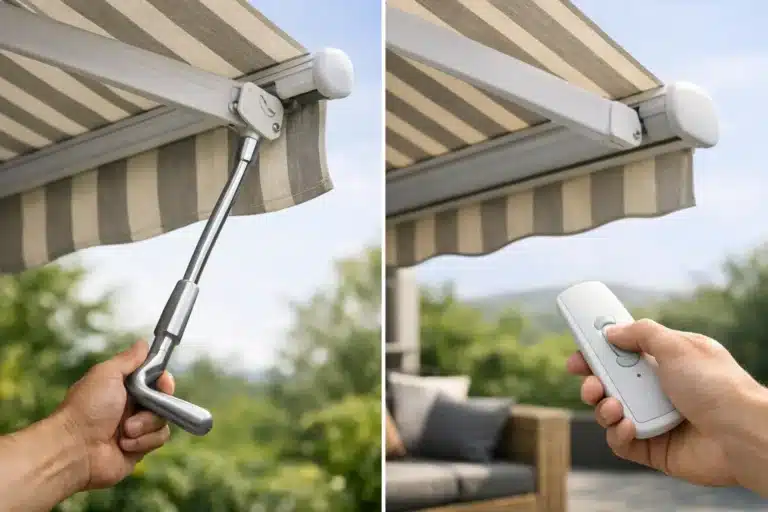
A beautiful retractable awning only improves daily life when it is easy to use. Awning motors turn a hot, bright patio into a comfortable place for breakfast, family dinners, poolside afternoons, or guest seating with the touch of a button. Rather than wrestling with a hand crank when the sun shifts, you can extend the shade when you need it and retract it when the day is done.

For homeowners, the appeal is simple: more comfort with less effort. For restaurants, hotels, and outdoor retail spaces, motorized operation helps staff manage shade quickly and maintain a polished guest environment. The right motor should feel quiet, dependable, and appropriately matched to the size and style of the awning it operates.
What an Awning Motor Actually Does
An awning motor sits inside the roller tube, where it rotates the fabric in and out. It replaces manual cranking with powered movement, allowing the awning to extend and retract through a wall switch, remote control, app, or automated sensor.
The motor does more than add convenience. Because it delivers consistent movement, it can help the awning open and close smoothly when properly installed and adjusted. That matters for preserving the look of the fabric and keeping your outdoor area ready to use without turning shade into another household task.
Motorization is especially useful for larger awnings. A broad patio cover can take considerable effort to crank by hand, and it may be impractical for someone who cannot comfortably reach or operate a manual mechanism. For a commercial setting with several awnings, powered operation gives employees a practical way to respond to changing sun, heat, and weather conditions.
Choose Awning Motors for the Awning, Not Just the Patio
The best motor is not necessarily the most powerful option on a product sheet. It is the one sized for the awning’s width, projection, fabric weight, and operating system. An undersized motor may struggle, move slowly, or wear out prematurely. A motor with more capacity than necessary is not automatically a problem, but it should still be compatible with the roller tube and awning design.
Start with the awning itself. The manufacturer or dealer should identify the proper motor range based on the total load the motor must move. Fabric selection matters here. Heavier, thicker materials and larger projections create more load than a compact awning with lightweight fabric.
A quality shade specialist will also consider how the awning is mounted. Wall-mounted, roof-mounted, freestanding, and pergola-style systems do not all operate the same way. A motor designed for one configuration may not be the right solution for another.
Consider How Often You Will Use It
A patio awning that opens for weekend entertaining has different demands than a restaurant awning adjusted throughout the day. Frequent use calls for dependable components, sensible controls, and a service plan that supports the installation over time.
For residential projects, choose the operation method that fits your routine. If the awning is used every afternoon, a remote or wall switch may be all you need. If you travel often, have a second-story awning, or want to protect outdoor furnishings from intense sun, automation may be worth considering.
Commercial property owners should think about who will operate the system. Simple, consistent controls reduce staff training and make it easier to establish opening and closing procedures. For multi-awning projects, coordinated control can also create a more uniform appearance across the property.
Wired, Plug-In, and Solar Power Options
How an awning receives power affects the installation process, cost, and finished appearance. There is no universal best choice. The right setup depends on where the awning is located and what electrical access already exists.
Hardwired motors are a clean, permanent solution when electrical work is planned as part of a new build or patio renovation. The wiring can be concealed for a more finished look, and a dedicated wall switch is easy to use. This approach typically requires a qualified electrician, particularly when outdoor-rated connections or new circuits are needed.
Plug-in motors can be a practical fit when a protected outdoor outlet is nearby. They may simplify installation and avoid more extensive electrical work, although the cord location should be planned carefully so it does not detract from the patio or create a hazard.
Solar-powered motors offer flexibility when running electricity to the awning would be difficult or disruptive. A compact solar panel charges a battery, allowing the motor to operate without a nearby outlet. They can be an excellent option for certain installations, but their suitability depends on available sunlight and the expected level of use. A heavily shaded wall or a high-use commercial application may call for another power source.
Controls Should Match the Way You Live Outdoors
The control choice shapes how natural motorized shade feels in everyday use. A handheld remote is convenient for most patios, especially when you want to adjust the awning from a lounge chair or outdoor dining table. A wall switch provides a fixed, familiar control point near a door.
Smart controls can add another layer of convenience. Depending on the system, you may be able to operate the awning through a mobile device, create schedules, or pair it with other home features. This can be useful, but it is not essential for every project. A straightforward remote-controlled awning remains a reliable, user-friendly choice for many homes.
When comparing control options, focus on practical questions. Will everyone in the household know how to use it? Is the control easy to access from the main patio entrance? Can a property manager or staff member operate it without relying on one person’s phone? The best setup is the one people will use correctly and confidently.
Weather Sensors Add Protection, With One Important Caveat
Sun sensors can extend an awning when bright conditions reach a preset level, helping keep a patio cooler before you step outside. Wind sensors can retract it when gusts become too strong. Rain sensors may also be available for selected systems.
For many owners, wind sensing is the most valuable form of automation. Retractable awnings are designed for sun protection, not for severe weather. Leaving one extended during high winds can damage the fabric, frame, mounting points, or motorized components. Automatic retraction offers useful backup when weather changes quickly.
Still, sensors do not replace good judgment. No awning should be treated as a storm shelter, and no automated feature can guarantee protection in every condition. Retract the awning when strong weather is forecast, when leaving the property for an extended period, or whenever the manufacturer’s guidance calls for it.
Installation Quality Protects the Motor and the Awning
Even a premium motor cannot compensate for an awning that is poorly mounted, out of level, or incorrectly adjusted. Proper installation begins with a sound mounting surface and the correct brackets for the building structure. The roller tube, arms, and fabric must be aligned so the motor can operate without unnecessary strain.
Limit settings are another key detail. These settings tell the motor where to stop when the awning is fully extended and fully retracted. If they are not set correctly, the fabric may not sit neatly, the awning may not close fully, or components may be put under avoidable pressure.
This is where experienced guidance matters. As an authorized SunPro dealer serving Charlotte, NC, Simpli Shaded helps customers choose solutions that suit both the awning and the outdoor destination they want to create. For designers, accurate specifications and dependable product support also make project planning more straightforward.
Keep Motorized Shade Performing Well
Awning motors are low-maintenance, but the complete system benefits from regular attention. Keep the fabric clear of loose debris, check that the arms and brackets appear secure, and listen for changes in sound or movement. If the awning begins moving unevenly, stops unexpectedly, or makes unusual noises, avoid forcing it through another cycle.
Clean the fabric according to its care instructions and allow it to dry before retracting whenever possible. Moisture trapped in a closed awning can affect the fabric over time. Before each warm season, test the controls and sensor functions so small issues can be addressed before the patio becomes part of your daily routine.
A motorized awning is not just a convenience feature. It is a practical way to make shade available at the exact moment an outdoor space needs it, so your patio, deck, dining area, or guest terrace feels more comfortable and more inviting throughout the season.
Related on Simpli Shaded: Motorized retractable awnings in Charlotte · Motorized screens · What a motorized awning costs · 0% APR financing for qualified buyers · Areas we serve